

AI DAILY / AGENTS AND PRODUCTIVITY
Dots moves OpenAI's agents from conversation to continuous work.
Persistent agents aim to carry tasks across conversations. For a business, the test is useful work that is checked and completed.
The fact
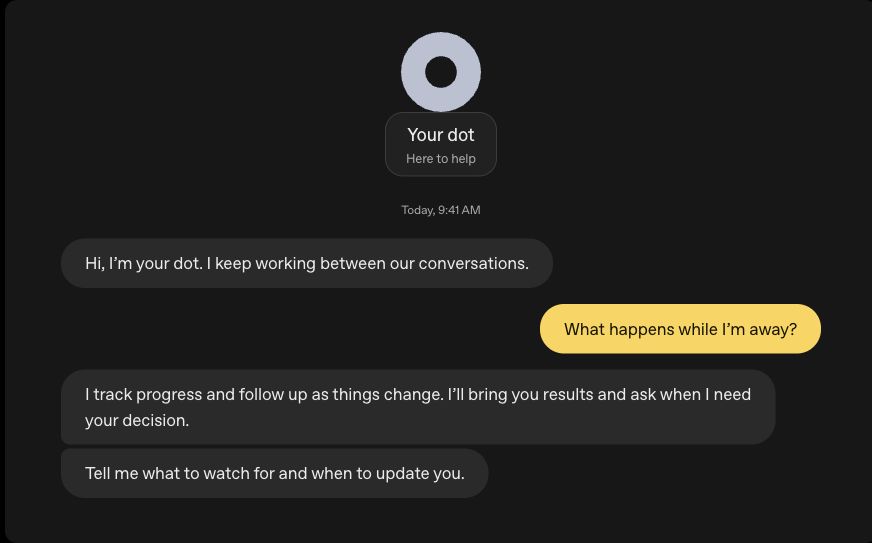
OpenAI introduced dots on September 29: GPT-6 Astra agents with their own cloud computer. The company began a gradual rollout to Pro and Business Premium in eligible markets; Enterprise beta access depends on administrator enablement.
What the product changes
The documentation describes continuity between conversations: task follow-up, persistent context and access to connected tools. Its cloud computer can keep working while the user's device is off. Access to that device's files and apps requires it to be connected and available; these are separate environments.
ALTA EDICIÓN's reading
The relevant economic unit shifts from a message toward a completed task. A business should compare the full cost of producing a valid result: setup, computing, review and correction. An impressive demonstration does not establish a repeatable productivity gain.
Cost and control
OpenAI distinguishes talking to a dot from asking it to run tasks in Codex or ChatGPT Work: those tasks continue to count toward normal usage limits. The company also describes permissions and action-review controls. Persistence means neither unlimited authority nor freedom from mistakes.
How we would test it
Choose a repeatable process, define a correct result and compare several cycles with the previous method. Measure total human time, incidents, cost and rework. Record when the agent should ask for a decision. Without that baseline, saving minutes at one stage may simply move work elsewhere.
The next signal
Track changes in availability and published terms alongside reproducible tests of completed tasks. We have not yet run a controlled test establishing net time savings, nor do we have evidence to translate this launch into OpenAI revenue or margins. The thesis would weaken if review and corrections absorb the time saved.
Sources, dates and method
OpenAI · Introducing dots
2026-09-29
OpenAI / ChatGPT Learn · Meet dots
Consultada / Retrieved 2026-09-30
Retrieved: September 30, 2026. Original synthesis and analysis by ALTA EDICIÓN. Scenarios and proposed tests are editorial interpretation; announcement and availability dates are distinguished explicitly.